








A perfect restaurant POS (Point-of-Sale) system today is an all-in-one technology platform that automates every step of a restaurant’s workflow. It should handle orders (in-house, takeaway, delivery apps) on tablets or touch terminals, send kitchen tickets automatically, update inventory in real time, process payments securely, and generate detailed reports for managers Modern trends emphasize cloud connectivity and mobility: restaurant POS solutions now often run in the cloud with tablet-based terminals, integrate with third-party apps, and support digital wallets In short, the ideal POS is user-friendly, fast, and connected across front- and back-of-house operations, improving accuracy and efficiency from the moment an order is placed until the bill is settled.
Bangladesh’s Restaurant Industry: Rapid Growth and New Categories
Bangladesh’s restaurant and foodservice sector has expanded dramatically in recent years, driven by urbanization, rising incomes, and changing lifestyles. Young professionals and families increasingly dine out or order in, pushing demand for diverse dining experiences. Rising disposable incomes mean more people can afford occasional meals at cafes and mid-range restaurants, while interest in international and fusion cuisine is growing. For example, the presence of a diverse range of Chinese residents in Bangladesh has spurred the popularity of Chinese and other Asian cuisines, and many restaurants now offer healthier or fusion menu items to appeal to evolving tastes.
Restaurant POS
Several distinct segments have emerged in Bangladesh’s restaurant landscape:
- Quick-Service & Fast Food (QSR): International chains and local street-food vendors coexist. Many popular brands entered Dhaka’s market in the 2000s, introducing Western fast food alongside local fried snacks and street fare. Urban lifestyles and digital ordering apps (Foodpanda, Shohoz, etc.) have made QSR very popular – busy customers value the speed and convenience of burgers, fried chicken, sandwiches or biryani they can grab or have delivered quickly. Studies note that urbanization and hectic work routines are major factors driving this segment.
- Casual and Fine Dining: A growing middle and upper class has spurred upscale dining. Numerous multi-cuisine and fine-dining restaurants now operate in Bangladesh. International cuisines and higher-end steak or seafood restaurants cater to customers seeking a premium experience. While formal data are scarce, industry analyses highlight that higher incomes and a desire for unique culinary experiences are pushing this segment
- Food Courts & Mall Outlet: Shopping malls, universities, and large office complexes increasingly include food courts. These host multiple fast-food counters or cafes under one roof. Food courts are an efficient model for single-brand operators or small chains, providing a built-in stream of customers in a communal setting.
- Cloud Kitchens & Delivery-Only Models: A new trend accelerated by COVID-19 is delivery-focused kitchens without dine-in seating. Often called “cloud kitchens” or “ghost kitchens,” these facilities prepare food solely for delivery through apps. In Bangladesh this model is flourishing because startup costs are low: entrepreneurs avoid high rent and decor expenses, and can launch multiple brands from one kitchen. Cloud kitchens offer flexibility, and benefit from Bangladesh’s booming online food delivery platforms. Experts report that, with digital ordering and cheap shared kitchen spaces, cloud kitchens give restaurateurs higher profit margins and faster expansion potential.
- Bakeries, Cafes, and Others: Specialty outlets like bakeries, coffee shops, and casual snack bars have also proliferated. These venues often use a similar POS system to track recipes and ingredients, take café orders, and issue combined bills.
So, Bangladesh’s dining market is diverse and expanding. Growth drivers include urbanization, rising disposable income, and the convenience of online ordering and mobile payments. Food-delivery apps and digital wallets (bKash, Nagad, etc.) are now mainstream, encouraging restaurants to adopt modern POS technology.

Restaurant POS
Essential POS Features for Restaurants
A restaurant POS must cover all core operations of the business. Key functional areas include order management, kitchen coordination, inventory, customer management, payments, analytics, and compliance. The POS should seamlessly tie these together on a single platform. Major categories of POS features include:
- Order & Table Management: The POS should let servers enter dine-in orders by table (often via handheld tablets) and track their status. It must also handle takeout or delivery orders. Orders entered at the register or mobile app should automatically send KOT (Kitchen Order Tickets) to the kitchen or display on a Kitchen Display System (KDS). This ensures kitchen staff see tickets in real time and can prepare dishes without miscommunication. Table management (tracking which tables are occupied, reservation details, split or merged bills) should also be integrated. For example, we can highlight features like “KOT/KDS” for kitchen coordination and “Table Merge / Bill Split” for flexible billing.
- Inventory & Recipe Tracking: An ideal POS keeps a real-time ingredient inventory. When each order is placed or an item is sold, the system should deduct the necessary ingredients from stock, alerting staff if supplies run low. This prevents over-ordering or shortages. Mediasoft notes that their POS provides one-click inventory reports, waste tracking, and “powerful stock management”. It can even manage recipes (bill of materials) so that, for example, if a chicken curry sells, the POS deducts rice, chicken, and spices accordingly. Good inventory integration ensures food costs are controlled and purchasing is optimized.
- Multi-Channel Order Integration: Modern customers order through many channels: in-person, phone, mobile apps, or third-party aggregators (Foodpanda, Uber Eats, Shohoz). The POS should aggregate all orders into one dashboard. Having a unified view prevents double-entry and confusion. When Foodpanda or Shohoz orders arrive, the POS should automatically import them, print tickets, and update inventory just like regular orders.
- Payment Processing: The POS must accept all common payment methods. This includes cash (with a secure cash drawer), credit/debit cards (via integrated card readers), and local mobile wallets (like bKash and Nagad). Split-payment support (e.g., part cash, part card) and payment-on-account (tab or credit) are also useful. The system should securely record each transaction and automatically mark the order paid if integrated with a card machine or mobile payment API. In fact, “Multiple Payment Method” supports and notes that their POS can handle Bkash, Nagad, bank cards, etc.. Real-time payment tracking in the POS ensures a sales order is only closed when payment is confirmed.
- Promotions and Modifier Controls: A restaurant must often offer discounts or special deals (e.g., happy-hour prices, lunch combos, loyalty coupons). The POS should let managers define promotions by time, menu category, or customer group. It should also allow modifiers (e.g., “no onions”, “extra cheese”, “spice level”) to be easily entered so kitchens know exactly what to prepare. A flexible promotions engine helps drive sales (e.g, early-bird discounts) while maintaining control.
- Customer Relationship Management (CRM): Keeping a customer database is valuable for loyalty programs and personalized service. The POS should record customer details (name, contact, visit history) and track their orders and preferences. For example, an ideal system should include a “Customer Information” module where staff can see a patron’s past orders and tailor recommendations. Linking CRM and the POS enables issuing loyalty points or sending marketing emails. If a regular visitor’s birthday approaches, the system could automatically prompt a special offer.
- Analytics and Reporting: An ideal POS transforms transactional data into insights. It should produce end-of-day and monthly sales reports, tax summaries, inventory usage, and even labor cost reports. Charts of top-selling dishes, peak hours, and profit margins help owners make decisions (e.g., which dish to promote or when to schedule staff). Reports should be accessible remotely (via web or mobile app) so owners can check performance from anywhere. Having these analytics means business decisions are data-driven, reducing waste and improving profitability.
- Regulatory Compliance: In Bangladesh, restaurants must comply with the NBR (National Board of Revenue) VAT regulations. This includes issuing proper VAT invoices (Mushak forms) for sales. The POS must automatically generate and store digital copies of VAT invoices (Mushak-6.3) and any required debit/credit notes (e.g., Mushak-6.8 for returns). An NBR-compliant POS will also produce VAT returns and sales registers as prescribed by law.
- Kitchen Display System (KDS). Many restaurants now use digital kitchen screens instead of paper tickets. The POS should integrate with one or more KDS screens so chefs see orders in sequence, with built-in timers or color coding for pending/running/ready status. Mediasoft’s KDS feature improves coordination between kitchen and front staff, cutting errors and speeding service.
- Mobility and Offline Mode: Ideally, servers should be able to take orders tableside on mobile devices or tablets. The POS should synchronize with cloud servers but also operate if the internet is down. An ideal system will cache transactions locally and sync automatically once connectivity returns.
Overall, these features should work together seamlessly. The POS should feel like a single platform where everything is integrated: orders, inventory, and finance flow together.
You can find all the above-mentioned features and benefits in T-POS Restaurant POS software, which is a comprehensive solution developed by Mediasoft Data Systems Limited to streamline operations for restaurants, cafes, and other food service businesses.
Restaurant POS
Operational Benefits of Restaurant POS
Investing in a restaurant POS pays off in many operational gains. By automating core tasks, a POS improves efficiency, accuracy, and customer satisfaction:
- Faster, Error-Free Order Fulfillment. With a POS, orders entered digitally go straight to the kitchen, reducing mistakes from handwriting or miscommunication. This solution observes that automated order routing “streamlines kitchen operations” and makes coordinating orders smoother. The reduction in human error means customers get exactly what they ordered. Faster printing of tickets and clear modifiers also speed up preparation and serving.
- Reduced Labor and Time Costs. Digital order-taking speeds up table service. Servers can ring up and pay bills tableside with tablets, eliminating trips to a fixed register. In one survey, restaurants switching to cloud POS noted they spent less time on back-office accounting. Streamlined processes mean staff can serve more guests in the same time. In short, POS technology lets teams focus on guests rather than paperwork.
- Integrated Multi-Channel Sales. POS unifies dine-in and delivery orders. For example, when Foodpanda delivers orders, the POS logs those sales automatically. This eliminates double-counting or missing orders. Owners gain a comprehensive sales view – no matter how a customer orders, it’s tracked in one system. This also ensures accurate inventory usage across all channels.
- Accurate Financial Tracking. The POS records every sale with details of items, taxes, and payments. It can generate day-end cash reports and feed data into accounting software. This makes bookkeeping straightforward and reduces theft or cash shortages. Restaurant owners get real-time visibility of daily revenue and profits, rather than waiting for manual tallies.
- Inventory & Cost Control. Automated stock tracking helps cut waste. If milk or chicken is low, the POS alerts managers before they run out. Knowing exactly what’s on hand prevents last-minute ingredient shortages (and emergency purchases at inflated prices). Over time, restaurants can reduce food cost percentages by ordering only the needed supplies.
- Enhanced Customer Experience. A POS-enabled restaurant serves customers more quickly and accurately. Guests appreciate fast checkouts and digital receipts (email/SMS). Loyalty programs built into the POS reward repeat visits. According to industry guides, faster service and order accuracy “enhance customer experience”. For example, T-POS lets staff call up a customer’s history to suggest favorites or apply earned discounts, making guests feel recognized and valued.
- Data-Driven Decisions. Because a POS logs everything, managers can analyze sales patterns. They can identify best-selling items or slow-moving dishes and adjust menus accordingly. Dynamic pricing or targeted promotions become possible with analytics. Without a POS, gathering such insights would require painstaking manual record-keeping.
In summary, a good restaurant POS boosts efficiency from order to finance. It eliminates paper order pads and calculators, replacing them with integrated screens and reports. This not only saves staff time and labor costs but also improves accuracy. As a result, operations run more smoothly, profits are easier to calculate, and customers enjoy a modern, seamless dining experience.
T-POS by Mediasoft: An All-In-One Solution
Mediasoft Data Systems Limited, a leading POS provider company in Bangladesh with 25 years of experience, offers T-POS, a restaurant management POS designed for the local market. T-POS embodies the ideal feature set described above, packaged in a single platform. Some of its notable capabilities include:
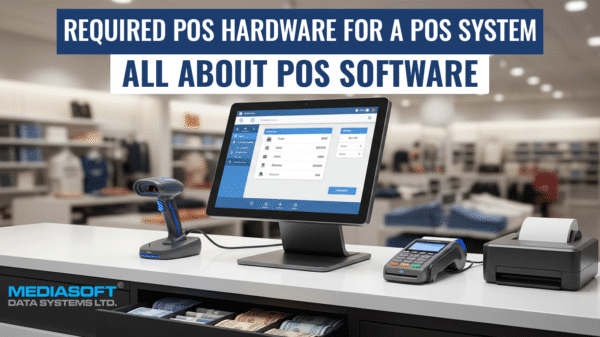
- Comprehensive Ordering & Kitchen Support: T-POS allows table-side ordering on tablets (“tab-based order management”) and handles various service styles (self-service kiosks, pay-first counters, or traditional table billing). It fully supports KOT/KDS, with real-time displays in multiple kitchens. For example, it can operate multi-kitchen setups – useful for large outlets that have separate stations (grill, pizza oven, bakery, etc.). As seen below, T-POS runs on standard all-in-one touch terminals (shown in the figure): these terminals provide a touchscreen interface so staff can quickly select menu items and modifiers.
- Inventory & Menu Control: T-POS offers a powerful inventory module. It tracks raw ingredients and automates stock counts. Recipes (item BOMs) can be set up so the POS automatically deducts ingredients with each sale. Managers can pull one-click inventory reports and see cost-of-goods sold. T-POS also includes easy menu management: operators can update prices, change recipes, and set up menu item images or icons through the system. This makes it simple to adapt to ingredient shortages or promotions.
- Flexible Payment and Billing: Multiple payment modes are built in: cash, card, bKash/Nagad, even gift cards can be handled. The POS tracks real-time payment status and allows splitting a bill across payment types. It supports cashier logins (for cash accountability) and maintains full audit trails of every transaction. Importantly, T-POS is fully NBR-compliant – it can automatically print Mushak-6.3 VAT invoices and other required tax forms for every sale, which is mandatory under Bangladeshi law.
- Third-Party Integrations: T-POS connects with popular third-party services. For example, it integrates with food delivery platforms. Incoming orders from Foodpanda, Shohoz, Uber Eats, etc., can be fed directly into T-POS, so no manual re-entry is needed. On the payment side, it links with local mobile wallets like bKash, allowing customers to scan a QR code or pay via app. (Mediasoft specifically lists bKash and Nagad among supported payment methods.) These integrations mean the POS handles external orders and digital payments seamlessly.
- Promotions and CRM: T-POS includes a promotions engine to schedule discounts or combos (e.g., “buy one get one” or weekday specials). It also builds a customer database (with purchase history), enabling loyalty programs and personalized offers. For instance, if a customer frequently orders a particular item, the staff can suggest it on repeat visits. Such CRM features help grow repeat business.
- Scalable Architecture: The system is designed to grow with your business. Because Mediasoft has served lots of outlets, T-POS has been deployed in both small cafes and large chains. It supports multi-branch setups – each outlet can report to a central HQ. Reporting and data are centralized, so the owner of multiple restaurants can view consolidated sales or compare outlet performance. The multi-branch support (along with multi-user management) ensures that adding a new location or more cashiers is straightforward.
- Robust Reporting and Analytics: T-POS provides comprehensive reports: sales summaries, tax returns, stock reports, employee shift reports, and more. Managers can track sales by item, by daypart, or by staff member. These analytics are accessible through its dashboard. Mediasoft emphasizes that T-POS produces “powerful reports”, giving owners clear visibility into every aspect of operations and finances.
- Ease of Use and Support: Even with all these features, T-POS is built for restaurant staff. The interface is graphical and intuitive (the documentation touts an “inviting color and graphics” UI). Training new staff is quick due to simple navigation. Mediasoft also offers customer support and training to get restaurants up and running.
T-POS meets the criteria of an ideal restaurant POS for Bangladesh. It combines all necessary features into one platform – from table ordering to compliance – and is tailored to local needs. Its long track record (approved by NBR and used by well-known Bangladeshi restaurants attests to its maturity and reliability. For a restaurant owner, choosing T-POS means getting a solution that bridges the kitchen and cash register seamlessly, improving order accuracy, customer satisfaction, and back-end efficiency.
Conclusion
For Bangladeshi restaurateurs, a modern POS system is no longer a luxury but a necessity. The market’s rapid evolution – driven by urbanization, digital ordering, and more sophisticated dining preferences– demands a POS that can handle complex, multi-channel operations. An ideal system ties together front-of-house, kitchen, and finance. It ensures orders are accurate, inventory is controlled, and tax compliance is automatic.
T-POS by Mediasoft exemplifies these qualities. It is a comprehensive, NBR-compliant POS platform built for restaurants of all kinds in Bangladesh. By investing in such technology, restaurant owners can improve service speed and precision, gain better financial insights, and focus on delighting customers rather than wrestling with paperwork.